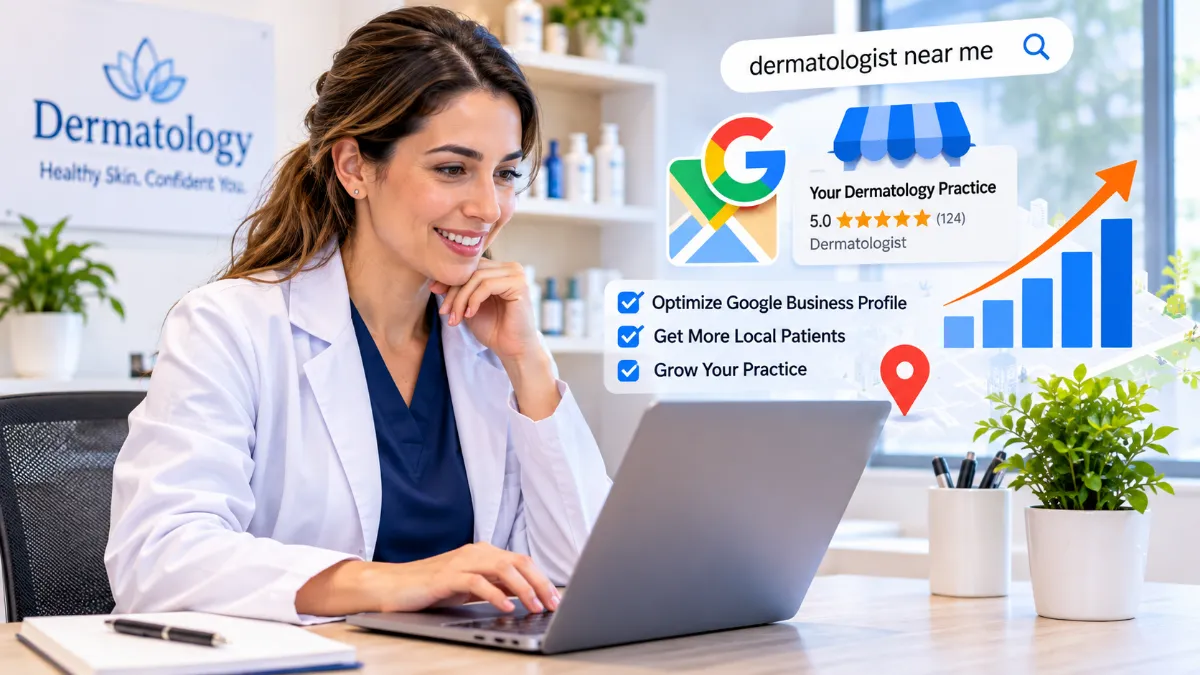
Running a dermatology practice takes clinical focus, time, and a reliable team. Yet even a well-run clinic can struggle to reach people who are actively looking for a dermatologist. That is where dermatologist marketing comes in. It connects a practice’s services with people searching for care in its area, while giving them clear information about the clinic and how to make contact.
For a US dermatology practice, marketing should do more than increase website visits. It should help the right local audience find accurate service information, understand what makes the practice suitable for their needs, and request an appointment without confusion. This guide explains the main parts of a practical strategy and how they work together.
Table of Contents
What Is Dermatologist Marketing?
Dermatologist marketing is the coordinated use of digital and local marketing activities to make a dermatology practice visible to relevant audiences and encourage appropriate appointment inquiries. It can support medical dermatology, cosmetic dermatology, or a practice that offers both, but the message should reflect the services the clinic actually provides.
For example, a clinic offering general dermatology may need clear pages about its services, provider credentials, insurance information, location, and appointment process. A practice focused on cosmetic services may also need educational pages that explain consultations, treatment suitability, expected processes, and how to contact the clinic. The strategy should start with the practice’s real services rather than a generic list of marketing tactics.
Why Does Marketing Matter for Dermatology Practices?
Many prospective patients begin their search online. They may compare nearby practices, review provider information, check office hours, look for a specific service, or read patient feedback before deciding whom to contact. If a clinic’s information is incomplete or difficult to find, a potential patient may choose another practice that communicates more clearly.
A consistent marketing strategy helps a practice improve local discovery, explain services, build confidence through accurate information, reduce booking friction, and measure demand. The aim is to help suitable patients find the practice and understand how to contact it, not simply to increase page views.
What effective marketing should help a practice do
- Improve local discovery: Help people find the practice when they search for dermatology services in their area.
- Explain services clearly: Give visitors accurate information about services, providers, location, and appointment steps.
- Build confidence: Present professional biographies, helpful educational content, clear policies, and genuine patient feedback where permitted.
- Reduce booking friction: Make phone numbers, forms, directions, and appointment options easy to find.
- Measure demand: Identify which channels generate qualified inquiries rather than judging success by traffic alone.
Which Marketing Channels Should a Dermatology Practice Use?
Most practices do not need to invest heavily in every channel at once. Start with the channels that match the clinic’s location, services, audience, budget, and capacity to respond to inquiries.
| Marketing channel | What it helps with | Practical starting point |
|---|---|---|
| Local SEO | Visibility for relevant searches in the clinic’s service area | Accurate business details, location pages, and a complete Google Business Profile |
| Website and service pages | Explaining services and turning visits into inquiries | Clear service descriptions, provider information, contact details, and booking paths |
| Educational content | Answering common questions and supporting informed decisions | Clinician-reviewed articles and useful service FAQs |
| Paid search advertising | Reaching people searching for selected services | Focused campaigns with relevant landing pages and conversion tracking |
| Reputation management | Helping people assess the practice’s patient experience | Consistent feedback processes and professional responses |
| Social media | Sharing practice updates and educational information | A realistic posting schedule and content reviewed by the practice |
1. Local SEO and Google Business Profile
Local SEO helps search engines understand where a practice operates and which services it offers. Start by keeping the clinic’s name, address, phone number, hours, website, and categories accurate across its online presence. The practice’s Google Business Profile should represent the real business, not a collection of extra keywords or promotional claims.
Google recommends accurate business information and genuine customer reviews. Its guidance prohibits offering incentives in exchange for reviews. A practice can invite patients to share honest feedback, but it should not pressure them or attempt to control what they say. Review Google’s guidance on getting more reviews before creating a review request process.
For a broader foundation, BrandUmark’s guide to building an SEO strategy explains how keyword targeting, site structure, and content planning fit together.
2. A Website That Answers Practical Questions
A dermatology website should make essential information easy to locate. Visitors should not have to search through several pages to find the clinic’s address, provider details, services, accepted insurance information if applicable, or appointment contact options.
Useful website elements
- A dedicated page for each major service the practice genuinely offers.
- Provider biographies with relevant qualifications and professional experience.
- Accurate location details, office hours, phone number, and directions.
- Clear appointment instructions and accessible contact options.
- Helpful answers to common administrative and service-related questions.
- Mobile-friendly layouts, readable text, and fast-loading pages.
Website performance and usability should be reviewed regularly. Google PageSpeed Insights can help identify performance issues. BrandUmark also explains the relationship between SEO and digital marketing in its related guide.
3. Educational Content and Service FAQs
Useful content gives visitors a clearer understanding of the practice. A dermatology clinic might publish clinician-reviewed explanations of its services, what happens during an initial consultation, how to prepare for an appointment, or what information patients should bring.
Keep the content within the practice’s expertise. Avoid diagnosing readers, presenting a typical result as guaranteed, or using dramatic claims to attract clicks. Every medical statement should be checked by an appropriately qualified reviewer before publication.
For planning and evaluating content, a practice can use SEO marketing tools to research queries and review page performance. Google’s SEO Starter Guide is also a useful reference for creating search-friendly pages without writing only for search engines.
4. Paid Search and Social Media
Paid search can help a practice appear for selected service-related searches while its organic visibility develops. Campaigns should use relevant keywords, accurate ad copy, suitable geographic targeting, and landing pages that match the advertised service. Set a budget the practice can afford to test and monitor; do not assume that more clicks automatically mean more appointments.
Social media can support awareness by sharing practice updates, clinician-approved educational material, and information about the clinic. Choose platforms based on the audience and the team’s ability to maintain them. A neglected profile with outdated information can create more confusion than value.
How Do You Build a Practical Dermatologist Marketing Strategy?
A useful plan connects the clinic’s business priorities to the questions prospective patients ask and the actions the practice wants visitors to take. Use this sequence to create a manageable starting point.
- Define the practice’s services and audience.
List the services actually offered, the locations served, the providers involved, and the types of inquiries the clinic wants to receive. - Review the current online presence.
Check the website, service pages, Google Business Profile, contact information, reviews, and mobile experience. BrandUmark’s SEO analysis guide can help structure this review. - Choose a small set of priorities.
For example, improve local listings, create missing service pages, or fix a confusing appointment form before launching several campaigns. - Assign responsibility for inquiries.
Make sure calls, forms, and messages are monitored and routed to the right team member. Marketing cannot help much if prospective patients do not receive a timely response. - Track results and refine the plan.
Use analytics and Search Console to review website performance, and connect those findings with the practice’s own appointment and inquiry records.
Google Search Console can show how a website performs in Google Search, while Google Analytics can help measure website activity. Configure tracking carefully and avoid placing sensitive patient information in analytics tools or marketing platforms.
How Should a Dermatology Practice Measure Marketing Results?
Measure outcomes that help the practice make decisions. Traffic and social engagement can provide context, but they do not show the full picture. A clinic should review whether marketing activity is producing relevant inquiries and whether the practice can convert those inquiries into scheduled appointments.
| Metric | What it tells you | What to review |
|---|---|---|
| Organic search impressions and clicks | How pages appear and attract visits from search | Search Console query and page reports |
| Calls and form submissions | Whether visitors are contacting the practice | Website events and call records, configured with privacy safeguards |
| Appointment requests | Whether inquiries progress toward scheduling | Practice management records and front-desk reporting |
| Paid campaign cost per inquiry | How much advertising spend is associated with a tracked inquiry | Campaign cost, conversion quality, and follow-up outcomes |
| Review volume and themes | What patients publicly say about their experience | Feedback trends and response quality, without exposing patient information |
What Common Dermatologist Marketing Mistakes Should Practices Avoid?
- Trying every channel at once: Too many campaigns can stretch a small team and make results difficult to evaluate.
- Using generic service pages: Pages that do not explain the actual service, provider, location, or next step leave visitors with unanswered questions.
- Ignoring local listing accuracy: Incorrect hours, phone numbers, or addresses can create avoidable barriers.
- Chasing traffic instead of relevant inquiries: A high visit count is not useful if visitors are outside the service area or looking for something the clinic does not offer.
- Publishing unreviewed medical claims: Content should be accurate, appropriately qualified, and reviewed by a clinical professional.
- Failing to track follow-up: Without a process for handling calls and forms, a practice may not understand where prospective patients are dropping off.
Conclusion: How Can a Dermatology Practice Start Marketing More Effectively?
Dermatologist marketing works best when it is built around the practice’s real services, local audience, and ability to respond to inquiries. A clear website, accurate local information, useful educational content, genuine reviews, and carefully measured campaigns provide a practical foundation. The goal is not to use every marketing channel. It is to make it easier for suitable patients to find the practice and understand how to contact it.
Start with these steps:
- Audit the basics: Check the website, service information, local listing, and contact details.
- Fix the biggest barrier: Improve the page, listing, or booking step most likely to confuse a prospective patient.
- Choose one growth channel: Prioritise local SEO, educational content, or a focused paid campaign based on the practice’s needs.
- Measure meaningful actions: Review relevant inquiries and appointment requests, not just page views.
- Review and improve monthly: Use performance data and staff feedback to decide what to change next.
Frequently Asked Questions About Dermatologist Marketing
1. What is the most effective marketing strategy for a dermatologist?
There is no single best channel for every practice. A strong starting point is usually an accurate website, local SEO, a complete Google Business Profile, and a clear appointment process. The practice can add paid search, social media, and other channels based on its services, location, budget, and results.
2. How can a new dermatology practice attract patients?
A new practice can begin by publishing clear provider and service information, setting up accurate local business listings, and making its location and appointment process easy to understand. It should also build a consistent process for responding to calls and online inquiries. Local visibility generally takes ongoing work rather than a one-time setup.
3. Is SEO worth it for a dermatology clinic?
SEO can be valuable when people in the clinic’s service area search for dermatology services. It helps the practice build useful service pages and improve its visibility in relevant organic and local searches. Results depend on competition, website quality, location, and the consistency of the work.
4. Should dermatologists use paid advertising?
Paid advertising may help a practice reach people searching for selected services, especially when campaigns are carefully targeted and linked to relevant landing pages. The clinic should set a test budget, track inquiries, and review lead quality before increasing spend. Advertising claims should be accurate and reviewed for applicable professional and legal requirements.
5. How much does dermatologist marketing cost?
Costs vary with the clinic’s location, competition, services, goals, and the amount of work handled internally or by an agency. Website development, SEO, content, paid advertising, and reputation management have different cost structures. A practice should define its priorities and budget before choosing a package or campaign.