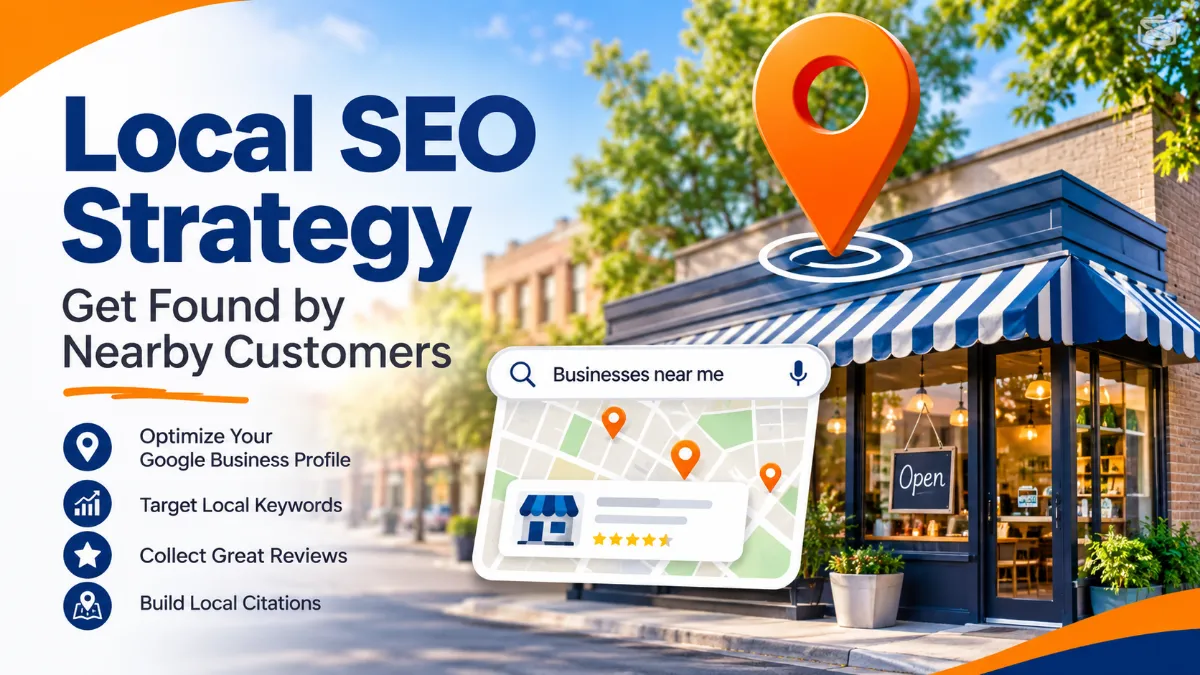
When someone searches for “plumber near me,” “best coffee shop in Manchester,” or “dentist in Austin,” they usually want a nearby business they can contact or visit. If your company serves a defined area, a focused local SEO strategy can help those customers discover you at the moment they are ready to take action.
Local search is not limited to shops with walk-in customers. Contractors, law firms, clinics, restaurants, home-service providers, professional offices, and service-area businesses can all benefit. The work is more specific than general SEO: you need to make your location, services, reputation, and service coverage clear to both search engines and people.
This guide explains how to build a practical plan, which signals to improve first, how to measure progress, and which mistakes can hold a local business back.
Table of Contents
- What Is Local SEO?
- How Local Search Works
- Optimize Your Google Business Profile
- Find Local Keywords and Search Intent
- Build Useful Local Website Pages
- Earn and Manage Customer Reviews
- Strengthen Local Citations and Links
- Handle Technical SEO and Local Schema
- Measure Local SEO Results
- Common Local SEO Mistakes
- A 30-Day Local SEO Action Plan
- Frequently Asked Questions
What Is Local SEO?
Local SEO is the process of improving a business’s visibility in search results for queries connected to a specific place or service area. It helps search engines understand what you offer, where you operate, and whether your business is a useful result for a nearby searcher.
For example, a bakery in Toronto may want to appear for “custom birthday cakes Toronto,” while an electrician in Birmingham may target searches such as “emergency electrician Birmingham.” A business that serves customers across several towns may need a broader service-area approach.
Local SEO overlaps with traditional SEO, but it puts extra emphasis on location relevance, business information, customer feedback, and local prominence. For a wider foundation, see our guide to building an SEO strategy.
How Local Search Works
Google describes local results through relevance, distance, and prominence (also referred to as popularity in its overview). These are useful planning concepts, not a formula that guarantees a particular position.
| Factor | What it means | What to improve |
|---|---|---|
| Relevance | How closely a business matches the search and the user’s intent. | Accurate categories, services, website content, and clear business descriptions. |
| Distance | How far the business is from the searcher or the location in the query. | Accurate address or service-area information. You cannot legitimately change where your business is located. |
| Prominence | How well-known and trusted a business appears to be. | Reviews, local mentions, links, reputation, and a strong online presence. |
The local visibility system
Manage local SEO as four connected workstreams, not a checklist of isolated ranking tricks.
Search results can differ from one neighbourhood to another because the searcher’s location and wording affect what appears. A company may be visible for a search made a few blocks away but less visible from the other side of a city. That is why local rank tracking should use a consistent set of locations and keywords rather than one manual search.
Optimize Your Google Business Profile
Your Google Business Profile is one of the most important assets in a local SEO strategy. It can show your business name, address, phone number, hours, services, photos, reviews, and other details directly in Google Search and Maps.
Claim and verify the correct profile
Start by finding out whether a profile already exists. Claim it if appropriate, complete Google’s verification process, and make sure the account is controlled by your business. Avoid creating duplicate profiles for the same location.
Complete the business information
Use your real-world business name. Choose the most accurate primary category and add relevant secondary categories only when they genuinely describe your business. Enter your phone number, website, opening hours, and address or service area carefully.
- Business name: Use the name customers recognize, not a string of extra keywords.
- Categories: Select the closest available category for your main service.
- Services: Add the services you actually provide and describe them clearly.
- Hours: Keep normal and holiday hours updated.
- Photos: Add genuine images of your premises, team, work, products, or completed projects.
- Website link: Send visitors to the most relevant page, not automatically to the homepage.
Use posts and profile features where useful
Publish updates when you have something useful to share, such as a seasonal service, event, new product, or change in opening hours. Add booking or appointment links if your business supports them. These features should help customers make a decision, not become a repetitive posting chore.
Strategist’s priority: fix the foundations before adding more activity
This order reduces wasted effort. There is little value in publishing more location pages if your core business information is wrong or customers cannot contact you.
Use Google’s official guidance on improving local rankings to understand the published relevance, distance, and prominence factors.
Find Local Keywords and Search Intent
Local keyword research starts with the way customers describe a service and the places they use to narrow the search. Do not assume every customer searches with the same wording. Some use a city name, others use a neighbourhood, postcode, nearby landmark, or “near me.”
Build a location and service keyword list
Write down your main services, the areas you genuinely serve, and the phrases a customer might use when looking for each service. Combine them selectively instead of creating hundreds of near-identical keyword variations.
| Business type | Example local keyword | Likely intent |
|---|---|---|
| Dental clinic | family dentist in Leeds | Compare local clinics and book an appointment. |
| Roofing contractor | roof repair in Columbus | Find a provider for a specific job. |
| Café | coffee shop near Oxford Street | Find a nearby place to visit now. |
| Accountant | small business accountant in Sydney | Evaluate expertise and request a consultation. |
Match the page to the search
A search for “emergency boiler repair” has a different intent from “boiler servicing prices.” The first person may need urgent contact information; the second may be comparing services and costs. Create or improve pages that answer the actual need behind the query.
Useful starting points include Google’s Keyword Planner and Search Console data from your existing website. For a more detailed process, read our guide on using Google Keyword Planner for SEO.
Build Useful Local Website Pages
Your website should confirm the information in your business profile and give visitors a clear next step. A strong local landing page explains what you do, where you do it, why customers should trust you, and how to contact you.
What a strong local landing page includes
- A clear page title and H1 describing the service and location.
- A concise explanation of the service and the customers it helps.
- Details about the actual service area, availability, and process.
- Original photos, project examples, or relevant case studies.
- Testimonials or review excerpts used with permission and in context.
- Answers to common local customer questions.
- A visible phone number, enquiry form, booking option, or directions.
Create location pages only when they add value
If you serve multiple cities, individual location pages can help explain the service available in each area. However, changing only the city name on a template and publishing dozens of almost identical pages creates a poor experience.
Give each page genuinely local information: jobs completed in the area, relevant service details, local customer questions, travel or coverage information, and the right contact path. If you do not have a meaningful presence or service offering in a location, do not imply that you do.
Connect pages with internal links
Link from your main service page to relevant location pages, and from location pages back to the core service information. Use descriptive anchor text that tells visitors what they will find. This helps people navigate and gives search engines context about the relationship between your pages.
For example, a home-services company might link from its “Drain Cleaning” page to a useful “Drain Cleaning in Leeds” page. Avoid repeating the exact same keyword-rich anchor in every paragraph. Our SEO strategies guide covers broader on-page and site-structure practices.
Earn and Manage Customer Reviews
Reviews help potential customers judge whether your business is reliable. They also contribute to the wider reputation signals that can support local prominence. A review plan should make it easy for genuine customers to share honest feedback without pressuring them to leave a positive rating.
Ask at the right moment
Request feedback after a completed job, successful appointment, delivery, or other meaningful customer interaction. Use a direct review link in a follow-up email, receipt, or message. Keep the request polite and neutral.
Respond to positive and negative reviews
Thank customers for positive feedback with a brief, specific response. For a complaint, acknowledge the concern, avoid sharing private details, and offer an appropriate way to resolve the issue offline. A calm response can reassure future customers even when the original review is critical.
A simple review request
“Thank you for choosing us. If you have a moment, we would appreciate an honest review of your experience. Your feedback helps other local customers understand what to expect.”
Never buy reviews, post fake reviews, or offer rewards in exchange for a particular rating. Google prohibits fake engagement and incentivized reviews, including discounts or free goods offered for posting, changing, or removing a review. See its prohibited and restricted content policy. A steady flow of authentic feedback is more sustainable than a sudden burst of suspicious activity.
Strengthen Local Citations and Links
A local citation is an online mention of your business details, often including its name, address, and phone number. Citations may appear in business directories, professional associations, local chambers of commerce, industry platforms, and community websites.
Keep core business details consistent
Prepare one approved version of your business name, address, phone number, website, and opening hours. Use it when updating important listings. Small formatting differences are not always a problem, but conflicting addresses or old phone numbers can confuse customers and make your online presence harder to maintain.
Choose relevant directories, not every directory
Prioritize reputable platforms that customers in your market actually use. A local chamber of commerce, recognized trade association, or respected industry directory may be more valuable than dozens of low-quality listing sites.
Earn links through real local involvement
Local links can come from sponsorships, community events, partnerships, supplier pages, local news coverage, useful research, and professional organizations. Focus on relationships and activities that make sense for the business. Do not pay for unrelated links or join schemes that promise hundreds of backlinks.
| Local opportunity | Example action | Why it can help |
|---|---|---|
| Community group | Sponsor a genuine neighbourhood event. | Builds awareness and may lead to a relevant mention. |
| Trade association | Join a legitimate professional organization. | Shows industry involvement and provides a relevant business reference. |
| Local publication | Offer useful expert commentary or original local data. | Creates an opportunity for editorial coverage. |
| Business partner | Publish a useful partner or supplier profile. | Connects your business with a relevant local network. |
Handle Technical SEO and Local Schema
Technical problems can prevent search engines from accessing important pages or make the website frustrating to use. Local businesses should treat technical SEO as a foundation, not a replacement for useful content and accurate business information.
Check mobile usability and page speed
Many local searches happen on phones. Make sure the phone number is easy to tap, forms work on small screens, text is readable, and important information appears without unnecessary scrolling. Compress oversized images and remove scripts or plugins that slow down key pages.
Test representative pages with Google PageSpeed Insights. Check your website’s indexing and search performance through Google Search Console.
Use structured data accurately
LocalBusiness structured data can help describe details such as a business’s name, address, phone number, opening hours, and other supported properties. Choose the most specific appropriate business type and ensure the markup reflects information visible on the page.
Structured data does not guarantee a rich result or a higher ranking. Validate your implementation, keep it current, and do not add invented ratings, addresses, services, or opening hours.
Make important pages crawlable
- Use clear URLs and descriptive page titles.
- Make sure important location and service pages are linked from relevant navigation or content.
- Use canonical tags appropriately when similar URLs exist.
- Submit an accurate XML sitemap and check indexing issues.
- Fix broken links, redirect chains, and accidental noindex settings.
If you need a broader technical review, our SEO audit tools comparison can help you explore options for checking website health.
Measure Local SEO Results
Do not judge a local SEO campaign by one ranking screenshot. Track several indicators so you can see whether more relevant people are discovering the business and taking action.
| Metric | Where to review it | What it tells you |
|---|---|---|
| Search queries and clicks | Google Search Console | Which queries bring visitors to your website and which pages receive impressions. |
| Profile interactions | Google Business Profile performance | How people discover and interact with your profile, subject to available reporting. |
| Calls and enquiries | Call records, forms, CRM, booking system | Whether visibility is producing business opportunities. |
| Local visibility | Consistent local rank tracking | How visibility changes across selected queries and geographic points. |
| Lead quality | CRM or sales records | Whether enquiries match your services, coverage, and ideal customer. |
Build a local SEO scorecard around business outcomes
Use these as reporting categories. Set targets from your own baseline; this graphic contains no invented industry benchmarks.
Set a baseline before making major changes. Review the same metrics each month and annotate meaningful updates, such as a new location page, profile category change, website redesign, or review campaign. Seasonality and changes in demand can affect results, so compare equivalent periods when possible.
Common Local SEO Mistakes
Local SEO often underperforms because businesses spread their effort across too many low-value tasks or publish information that does not reflect how they operate.
- Creating duplicate profiles: Multiple listings for the same location can confuse customers and create management problems.
- Adding keywords to the business name: Use the real-world business name rather than trying to manipulate relevance.
- Ignoring reviews: Unanswered questions and complaints can weaken customer confidence.
- Publishing thin location pages: Pages that only swap city names offer little value to visitors.
- Using inconsistent contact details: Old phone numbers or addresses make it harder for customers to reach you.
- Buying links or reviews: Manipulative tactics create risk and do not build a trustworthy reputation.
- Tracking only one location: A single manual search cannot represent visibility across an entire service area.
- Forgetting conversion paths: A visitor who cannot find a phone number, booking link, or clear next step may leave.
A 30-Day Local SEO Action Plan
You do not need to change everything at once. Use this 30-day plan to establish a reliable foundation, then continue improving based on customer needs and performance data.
- Days 1–5: Audit your business information.
Check your Google Business Profile, website contact details, opening hours, categories, address, and service area. Record duplicate or outdated listings that need attention. - Days 6–10: Research local searches.
List your core services, target locations, and customer questions. Group keywords by intent and map each important group to the most relevant page. - Days 11–15: Improve your website.
Update your main service page, improve calls to action, add useful local details, and connect related pages with descriptive internal links. - Days 16–20: Build trust signals.
Set up a simple review request process, respond to existing feedback, and identify a short list of relevant local directories or organizations. - Days 21–25: Check technical health.
Test mobile pages, page speed, indexing, broken links, sitemap status, and any LocalBusiness structured data you use. - Days 26–30: Establish measurement.
Record Search Console and profile performance, confirm enquiry tracking, and create a monthly review routine for visibility and leads.
After the first month, prioritize the changes that improve customer experience and lead quality. Local SEO is an ongoing process: business details change, competitors improve, customers ask new questions, and search behaviour shifts.
Frequently Asked Questions
1. What is the most important part of a local SEO strategy?
Start with accurate business information and a complete Google Business Profile, then make sure your website clearly explains your services and service area. Reviews, relevant local mentions, and technical health support that foundation. The right priority can vary by business and market.
2. How long does local SEO take to work?
There is no fixed timeline. Correcting inaccurate details may improve the customer experience immediately, while building visibility, reviews, and local authority usually takes sustained effort. Track changes over several months rather than expecting a guaranteed result by a specific date.
3. Do I need a physical address to rank in local search?
Not every local business serves customers at its premises. Service-area businesses can configure their profiles according to Google’s eligibility and address-display rules. Use genuine business information and do not use a virtual office or an address where the business is not eligible to operate.
4. How many location pages should my website have?
Create pages for locations where you have a real service offering and enough unique information to help visitors. A business serving five meaningful areas may need five useful pages, while another business may be better served by one strong regional page. Do not publish thin pages simply to target more city keywords.
5. Are Google reviews a ranking factor for local SEO?
Reviews contribute to how customers assess a business and are part of the broader local prominence picture. Google also advises businesses to earn reviews and respond to them. Do not buy reviews or try to control their wording or rating.
6. What is the difference between local SEO and traditional SEO?
Traditional SEO improves visibility for relevant searches more broadly, while local SEO focuses on searches connected to a location or service area. Local SEO places particular emphasis on business profiles, proximity, reviews, local citations, and location-focused website content. Many businesses need both.
7. Can a small business do local SEO without an agency?
Yes. A small business can manage core tasks such as updating its profile, improving service pages, requesting honest reviews, and monitoring Search Console. An experienced specialist may be useful when the business has multiple locations, technical problems, a competitive market, or limited time to manage the work.
8. How should I track local SEO performance?
Combine website query and click data, Business Profile interactions, calls, bookings, form submissions, and lead quality. If you track local rankings, use consistent keywords and geographic points. This gives a more realistic view than relying on a single search from one device.
Official References and Further Reading
The recommendations above are grounded in Google’s published documentation. Use these primary sources when checking policy details or implementing technical changes; features and documentation can evolve.
- Google Business Profile: Tips to improve your local ranking — Google’s explanation of relevance, distance, prominence, profile completeness, reviews, and photos.
- Google Business Profile: Prohibited and restricted content — policy guidance on fake engagement, paid reviews, and incentivized rating manipulation.
- Google Search Central: LocalBusiness structured data — supported structured-data properties and implementation guidance.
- Google Search Central: SEO Starter Guide — people-first content, descriptive links, and image best practices.
- Google Search Central: Creating helpful, reliable, people-first content — self-assessment questions for useful, original, trustworthy content.
- Google Search Console — monitor search queries, clicks, indexing, and website performance.
- PageSpeed Insights — assess page performance and user experience on representative pages.
Conclusion
A practical local SEO strategy connects accurate business information, useful website content, customer trust, and measurable outcomes. Start with your Google Business Profile, research the services and locations customers actually search for, improve the pages that answer those needs, and build a consistent process for reviews and local reputation.
Then measure what matters: qualified enquiries, calls, bookings, and customer actions. Make steady improvements based on evidence, and keep every detail honest and current. That approach gives nearby customers a clearer reason to find, trust, and contact your business.